


31 Jul Brand Messaging Statistics: USA 2025
Brand messaging shapes how businesses are perceived, remembered, and trusted. From the tone of a tagline to the emotion behind a product launch, messaging decisions influence everything from customer loyalty to competitive positioning. With so many ways to create and deliver a message, understanding what works and what matters most to business leaders has never been more important.
To find out what 4,029,450 opinions in the business leaders in the US were about brand messaging, we utilized AI-driven audience profiling to synthesize insights from online discussions over a year ending 7 July, 2025, to a high statistical confidence level. The results offer a detailed look at the traits, tools, and strategies shaping how organizations are communicating their core values, personality, and value proposition to their target audience.
Index
- For 14% of business leaders, building long-term loyalty is definitely an essential brand messaging goal
- 51% of business leaders agree that relatable storytelling definitely makes a brand message memorable
- 30% of business leaders think their current brand voice is calm and trustworthy
- 42% of business leaders always use email campaigns to deliver their brand’s message
- 40% of business leaders agree that low audience engagement might be their biggest brand messaging challenge
- 22% of business leaders say that a strong customer focus definitely makes their brand message resonate with their audience
- 75% of business leaders definitely believe that style guides and templates keep their team’s brand messaging aligned
- 72% of business leaders want their brand messaging to evoke feelings of calm and clarity
- 38% of business leaders always closely monitor competitors’ advertising campaigns
- 36% of business leaders agree that visual storytelling is absolutely essential for bringing a brand message to life
- Brand videos are always the preferred key brand messaging asset format for 47% of business leaders
- 40% of business leaders definitely want innovation to be the brand trait their audience remembers
- 69% of business leaders definitely believe in revisiting or refining their core brand messaging during product launches
- 52% of business leaders agree that content engagement metrics might be an effective way to gauge if a brand message works
- 30% of business leaders in the US might be primarily located in the Midwest
- Clear, consistent brand messaging still wins in 2025
- Methodology
Which Goal Best Reflects The Purpose Of Your Brand Messaging?
For 14% of business leaders, building long-term loyalty is definitely an essential brand messaging goal
While brand messaging serves many purposes, business leaders tend to favor a select few:
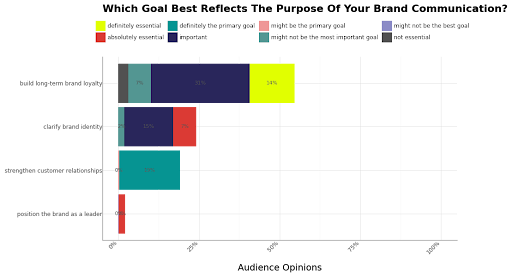
The goals that best reflect the purpose of brand messaging vary, but building long-term brand loyalty comes out on top. It’s considered definitely essential by 14% of US business leaders in our audience, important by 31%, might not be the most important goal by 7%, and not essential by 3%. This strong emphasis on loyalty is echoed in broader business strategy, too, with a recent PwC report revealing that more than 60% of executives are increasing their loyalty budgets.
Strengthening customer relationships also plays a key role, with 19% of business leaders saying it’s definitely the primary goal. Clarifying brand identity is absolutely essential for 7%, important for 15%, and might not be the most important goal for 2%. Just 2% say positioning the brand as a leader is absolutely essential.
What Do You Believe Makes A Brand Message Memorable?
51% of business leaders agree that relatable storytelling definitely makes a brand message memorable
Most strategies have their place, but one rises to the top for lasting impact:
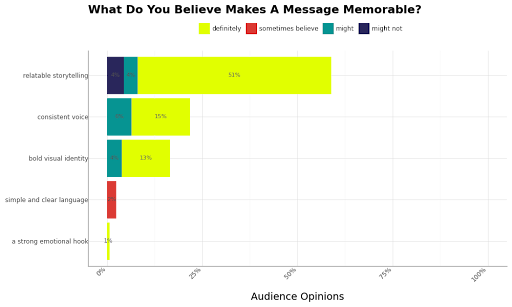
In defining what makes a brand message memorable, relatable storytelling leads by a wide margin. 51% of business leaders definitely believe in it, with another 4% saying they might and 4% saying they might not. That strong showing reflects how storytelling acts as a powerful differentiator by building emotional connections, helping brands stand out, and creating trust with the audience.
A consistent voice follows, with 15% saying it definitely adds to memorability and 6% saying it might. Bold visual identity is seen as definitely impactful by 13%, with 4% saying it might help. Just 2% sometimes believe simple language plays a role, and only 1% say a strong emotional hook makes a lasting impression, showing that while these elements do count, relatability is key overall.
How Would You Describe Your Current Brand Voice?
30% of business leaders think their current brand voice is calm and trustworthy
Brand voice preferences are spread out, with no one tone standing out:
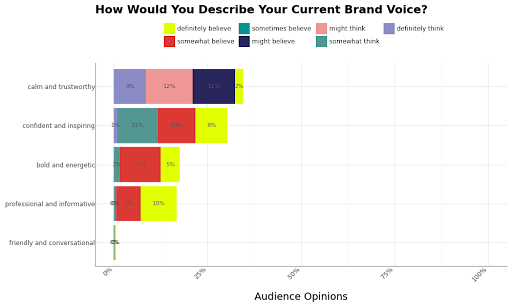
Business leaders in our audience lean in a few different directions in describing their current brand voice, but none dominate. While fewer strongly associate with a calm and trustworthy tone, its potential impact shouldn’t be overlooked, especially since customers who trust a brand are 88% more likely to become repeat buyers. That makes it surprising that just 2% definitely believe this tone reflects their brand voice, while 11% might believe it, 12% might think so, and 9% definitely think it does.
A confident and inspiring voice is definitely believed by 8%, somewhat believed by 10%, somewhat thought by 11%, and definitely thought by 1%. A bold and energetic brand voice is definitely believed by 5%, somewhat believed by 11%, and somewhat thought by 2%. A professional and informative voice is definitely believed by 10%, somewhat believed by 7%, and somewhat thought by 1%. Interestingly, a friendly and conversational brand voice received no engagement, suggesting that while it may be effective in certain contexts, it’s not currently a priority for the majority of business leaders.
Which Channel Do You Focus On Most To Deliver Your Brand’s Message?
42% of business leaders always use email campaigns to deliver their brand’s message
There are plenty of platforms to choose from, but one channel gets most of the attention:
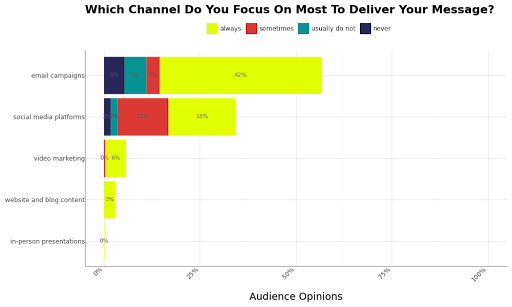
Business leaders in our audience rely on a range of channels to deliver their brand’s message, but email campaigns clearly take priority. 42% say they always focus on email, while 3% say they sometimes do, 6% say they usually do not, and 5% say they never use it. That level of commitment makes sense, especially since nearly 33% of marketing professionals reported a twofold increase in email ROI in 2024, and another 13.7% saw triple the returns.
Social media platforms are always used by 18%, sometimes used by 13%, usually not used by 2%, and never used by 2%. Video marketing is always used by 6%, and website or blog content by 3%, while in-person presentations received no engagement at all.
This shows that while business leaders use a mix of channels, email marketing remains the dominant and most trusted method for delivering brand messages, likely due to its proven high ROI and consistent performance.
What Is The Biggest Challenge You Face With Brand Messaging Today?
40% of business leaders agree that low audience engagement might be their biggest brand messaging challenge
While a few challenges pop up, one dominates the conversation:
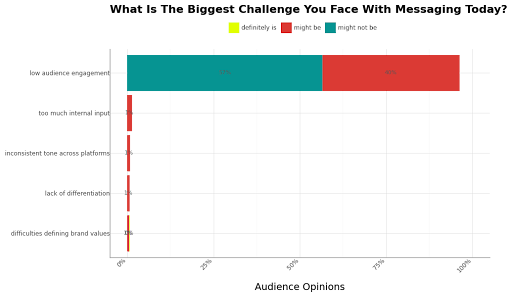
The challenges faced with brand messaging today reflect one clear pressure point, and that’s audience engagement. 40% of business leaders in our audience say low engagement might be the biggest challenge, while 57% say it might not be.
Beyond that, very few express concern about other possible obstacles. Just 1% say too much internal input might be the biggest challenge, and the same number point to inconsistent tone across platforms. Another 1% highlight a lack of differentiation as the biggest challenge, and 1% mention difficulties in defining brand values. The overall picture suggests that while leaders are paying attention to engagement, most other messaging concerns seem to be taking a back seat.
What Makes Your Brand Message Resonate Most With Your Audience?
22% of business leaders say that a strong customer focus definitely makes their brand message resonate with their audience
Business leaders have a few clear ideas about what helps their messaging land:
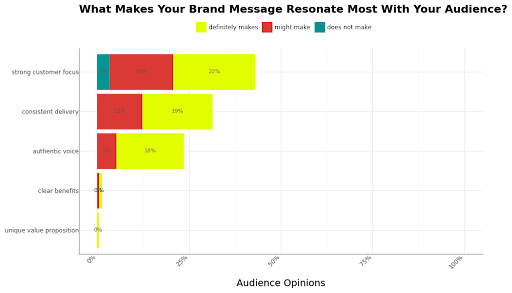
What makes brand messaging resonate with audiences most often comes down to a strong customer focus. 22% of business leaders in our audience say this definitely makes their message connect, while 17% say it might, and 3% say it does not.
Consistent delivery also plays a key role, with 19% saying it definitely makes their message resonate and 12% saying it might. That emphasis tracks, since consistent messaging across channels builds audience trust and has also been linked to revenue growth of up to 23%. An authentic voice definitely makes a brand resonate for 18% and might help for 5%. Clear benefits are definitely a key factor for just 1%, and a unique value proposition received no engagement at all, despite it being a commonly used marketing touchpoint.
How Do You Ensure Your Team Stays Aligned With Brand Messaging?
75% of business leaders definitely believe that style guides and templates keep their team’s brand messaging aligned
There’s a clear favorite when it comes to keeping teams on the same page:
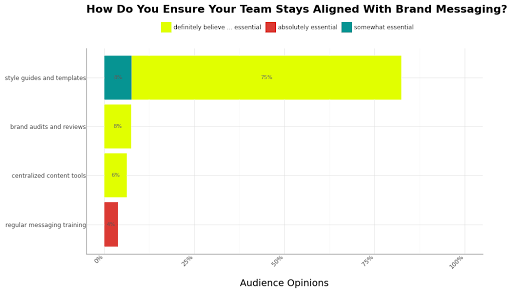
Ensuring team alignment with brand messaging often comes down to having the right tools and resources in place. Style guides and templates are by far the most relied-on approach, with 75% of business leaders in our audience saying they definitely believe these are essential, and another 8% saying they are somewhat essential.
Brand audits and reviews are seen as definitely essential by 8%, while 6% say the same about centralized content tools. Regular messaging training is viewed as absolutely essential by just 4%. The results suggest that clear documentation and structured materials carry more weight than audits or ongoing training efforts.
What Kind Of Emotion Do You Want Your Brand Messaging To Evoke?
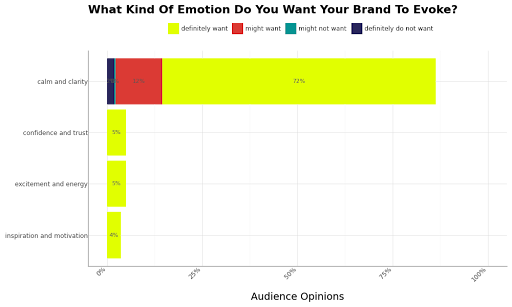
72% of business leaders want their brand messaging to evoke feelings of calm and clarity
One emotional goal dwarfs all others in how leaders want their brand messaging to land:
Using brand messaging to evoke an emotion in a target audience is crucial to forging lasting connections, and Google does this effectively in its Year in Search. By highlighting the year’s most popular search trends and events, the search engine inspires feelings of nostalgia, happiness, and inspiration, reminding audiences of the role it plays in helping them make sense of the world and their own experiences.
This approach reflects a broader trend, with a striking 72% of business leaders in our audience saying they definitely want their brand messaging to evoke feelings of calm and clarity. Another 12% say they might want to do so, while just 2% say they definitely do not.
Confidence and trust are something 5% definitely want to evoke, while another 5% definitely want their messaging to create excitement and energy. Inspiration and motivation are definitely the goal for 4%, putting them at the bottom, but revealing that they still hold some importance.
Which Competitor Behavior Do You Monitor Most Closely?
38% of business leaders always closely monitor competitors’ advertising campaigns
Not all competitor behaviors are treated equally, with one clearly in a league of its own:
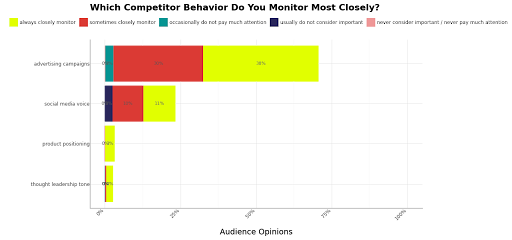
Monitoring competitive behavior is a key part of staying sharp in the market, and the U.S. Small Business Administration (SBA) encourages businesses to use competitive analysis to find a clear advantage. Business leaders in our audience seem to take that advice to heart, especially when it comes to tracking advertising campaigns. 38% say they always closely monitor competitor ads, while another 30% say they sometimes do. Just 3% say they occasionally don’t pay much attention.
Social media voice is always closely monitored by 11%, sometimes by 10%, and not considered important by 3%, while thought leadership tone is always closely monitored by 2%.
Notably, product positioning is only always closely monitored by 3%, and thought leadership tone by 2%, despite SBA guidance that understanding how competitors position themselves in the market is key to gaining a competitive edge.
Which Element Helps Bring Your Brand’s Message To Life?
36% of business leaders agree that visual storytelling is absolutely essential for bringing a brand message to life
Business leaders draw on a mix of tools to make their brand messaging more vivid and engaging:
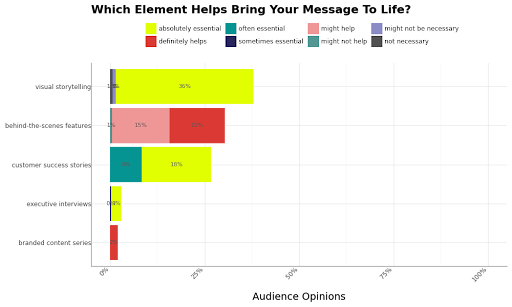
Some elements play a stronger role than others in bringing a brand’s message to life. Visual storytelling is seen as absolutely essential by 36% of business leaders in our audience, while just 1% say it might not be necessary, and another 1% say it is not necessary at all. That level of support is easy to understand, given that 65% of people are visual learners.
Customer success stories are also seen as effective, with 18% calling them absolutely essential and another 8% saying they are often essential. Behind-the-scenes features definitely help for 15%, might help for another 15%, but might not help for 1%. Exclusive interviews are absolutely essential for 3%, and 2% feel that branded content series definitely helps.
These figures highlight the fact that business leaders increasingly value emotionally resonant, visually engaging, and authentic content as key tools for building brand connection and trust.
What Format Do You Prefer For Key Brand Messaging Assets?
Brand videos are always the preferred key brand messaging asset format for 47% of business leaders
One format is front of mind for shaping brand messaging assets:
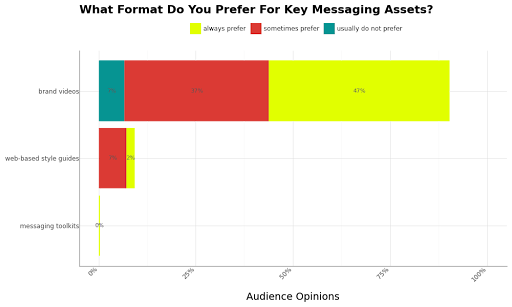
Business leaders have clear favorites when it comes to formats for key brand messaging assets, and video tops the list. A full 47% say they always prefer brand videos, another 37% say they sometimes do, and only 7% usually do not prefer this format. That strong showing lines up with broader marketing trends, with 95% of video marketers viewing video as a key part of their overall strategy.
Trailing well behind, web-based style guides are always preferred by 2% and sometimes by 7%, while messaging toolkits received no engagement. The results show a strong preference for rich, visual formats that feel more engaging than static documentation.
What Brand Trait Do You Most Want Your Audience To Remember?
40% of business leaders definitely want innovation to be the brand trait their audience remembers
Two brand traits rise to the top of the list for long-term recall:
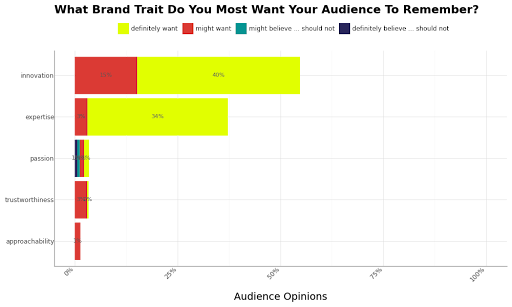
The brand traits you want your audience to remember can shape how your business is perceived long after the first impression. Innovation leads the way, with 40% of business leaders in our audience saying they definitely want this to be top of mind for their audience, and another 15% saying they might want it. That focus reflects the influence of innovative brands like Apple, Tesla, and Google, all of which are closely associated with forward-thinking ideas and continuous reinvention.
Expertise follows closely, with 34% saying they definitely want their audience to remember this trait and 3% saying they might. Passion is definitely important for 2%, might be for 1%, while another 1% might believe it should not be remembered, and 1% definitely believe it should not.
Rounding out the list, trustworthiness is selected by 3% as something they might want remembered, and approachability by 1%, making it of minimal importance compared to all other traits.
How Often Do You Revisit Or Refine Your Core Brand Messaging?
69% of business leaders definitely believe in revisiting or refining their core brand messaging during product launches
Some business milestones are far more likely to spark a messaging refresh:
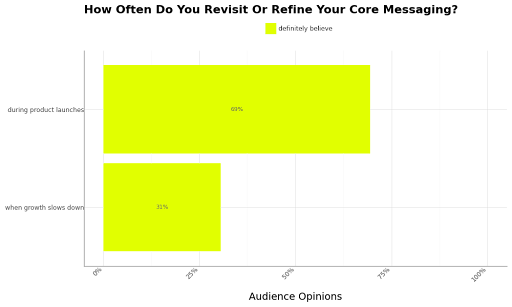
Refining core brand messaging isn’t tied to just one scenario, but product launches prompt the strongest response. 69% of business leaders in our audience say they definitely revisit their messaging at launch time, making it the most common trigger by a clear margin. In comparison, 31% say they definitely do so when growth slows down.
It’s evident that brand messaging is still viewed more as a way to amplify new opportunities, rather than as a tool to help reset direction during slower periods.
How Do You Test If Your Brand Message Is Working?
52% of business leaders agree that content engagement metrics might be an effective way to gauge if a brand message works
Some leaders watch for signs of engagement, while others want hard data:
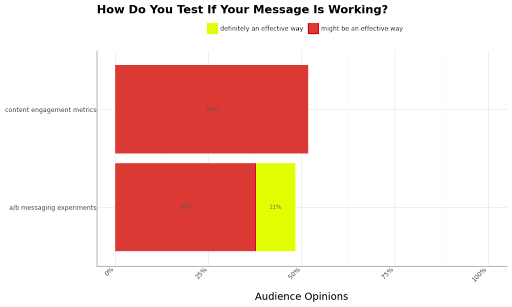
Testing if your brand message is working often starts with looking at how people engage with your content. 52% of business leaders in our audience say content engagement metrics might be an effective way to assess messaging impact. This aligns with broader thinking at the executive level, where 61% believe that delivering personalized experiences and fostering deeper engagement will be critical for growth.
However, A/B messaging experiments are seen as more definitive by some, with 11% saying they are definitely effective and another 38% saying they might be. This type of testing is tried-and-trusted, so it’s easy to see why so many also feel it’s a good way to determine which messages are working, and why.
Which Region Best Describes Your Organization’s Primary Location?
30% of business leaders in the US might be primarily located in the Midwest
There’s no clear consensus on which region best reflects where these organizations are based:
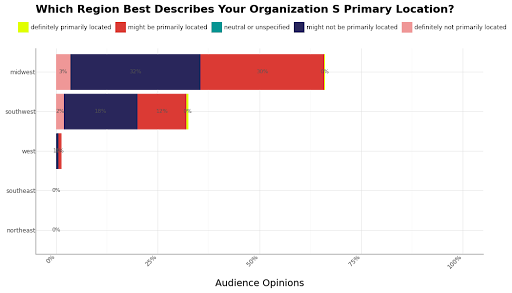
Views on which region best describes an organization’s primary location are fairly spread out, with no single area claiming a strong majority. The Midwest shows the most traction, with 30% of business leaders in our audience saying it might be their primary location, 32% saying it might not be, and 3% saying it is definitely not their primary location.
The Southwest follows, with 12% saying it might be their primary base, 18% saying it might not be, and 2% saying definitely not. Just 1% say the West might be their primary location, and another 1% say it might not be. The Southeast and Northeast garnered no engagement at all.
Clear, Consistent Brand Messaging Still Wins in 2025
The way a brand communicates can shape everything from reputation to reach. With input from more than 4 million US business leaders, this data offers a clear view into what matters most in messaging today.
The takeaways are practical, actionable, and rooted in real-world priorities. Whether the goal is to drive engagement, build loyalty, or sharpen positioning, strong brand messaging remains one of the most valuable tools available to any organization.
Methodology
Sourced using Artios from an independent sample of 4,029,450 business leaders in the United States’ opinions across X, Reddit, TikTok, LinkedIn, Threads, and BlueSky. Responses are collected within a 95% confidence interval and 2% margin of error. Results are derived from opinions expressed online, not actual questions answered by people in the sample.
About the representative sample:
- 51% of US business leaders are between the ages of 35 and 64.
- 53% identify as male and 47% as female.
- 36% earn between $120,000 and $200,000 annually.
- 34% are based in the Pacific US.
Sorry, the comment form is closed at this time.